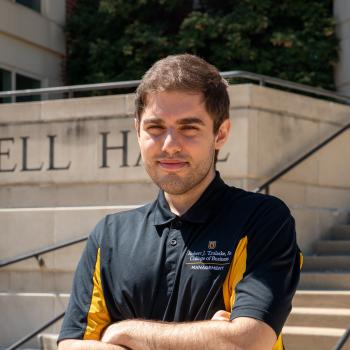
Cyrus Khalvati
Ph.D. Candidate in Management
University of Missouri
Biography
Hi! My name is Cyrus, I am a Ph.D. candidate in Management at the Trulaske College of Business at the University of Missouri.
My research examines how the design of human resource practices both predicts and shapes performance outcomes at employee and firm levels. My work has been invited for revision at the Journal of Applied Psychology and Personnel Psychology.
I completed my undergraduate studies in Vancouver, Canada, where I was born and raised.
I am eligible for the TN Visa for employment in the U.S. and do not require an H1-B visa.
Outside of research and teaching, I enjoy playing basketball, watching professional Esports, and spending time with friends and family.
Download my CV
Interests
- Performance Management
- Compensation
- Staffing
- Motivation
Education
- Ph.D. in Management, expected 2027 University of Missouri
- M.Sc. in International Business, 2022 University of Hertfordshire
- B.B.A. in International Business, 2020 Capilano University
Research
Published Papers
-
"Your Published Paper Title Goes Here"
- With Co-Author Name
- Accepted at the Journal of Management
- See the slides
We study [research topic and setting]. Large [subjects] generated [finding one] before [period], driven by [mechanism], but have [finding two] since. The median [subject] [finding three]. Due to [constraint], [subjects] increase [behavior]. Over time, [outcome], reducing [consequence].
Working Papers
-
"Your First Working Paper Title Goes Here"
- Semifinalist, Best Paper Award (Management), AOM 2025
- See the slides
[Research question and motivation.] This paper causally examines [topic] to evaluate [trade-off]. I find that [main result]. I instrument for [variable] using [instrument]. These effects are stronger for [subsample]. The results are driven by [mechanism] which results in [long-term outcome].
-
"Your Second Working Paper Title Goes Here"
- With Co-Author One, Co-Author Two, and Co-Author Three
- See the slides
Do [research question]? A causal effect is difficult to identify because [endogeneity concern]. We develop an instrument using [instrument]. We show [main result]: a [X]% increase in [treatment] reduces [outcome] by [Y] percentage points. [Additional finding]. We find no change in [null result], in part because [explanation].
-
"Your Third Working Paper Title Goes Here"
- See the slides
This paper studies the effects of [topic] on [outcome]. I use novel data from [data source] to document [descriptive finding]. [Units] are significantly more likely to [behavior] before [event]. I find some evidence of [secondary result] with an instrumental variables approach built around [instrument] confirming these results.
-
"Your Fourth Working Paper Title Goes Here"
- See the slides
[Prior work] estimates that [finding] decreases by [X] percent more under [condition A] than [condition B]. I document that [Y] percent of this magnitude is attributable to [mechanism]. I find no effect when extending results to [period]. I document an increase in [outcome] which suggests [implication]. These results cast doubt on [prior claim].
Other Publications
-
"Book Chapter or Other Publication Title", 2024, Book or Volume Title
- With Co-Author Name
- See the preliminary version
- See the slides
Teaching
Instructor
- MGMT 4030 – Organizational Behavior (4.8/5) · Fall 2025
- Download my Fall 2025 Evaluations
- MGMT 4030 – Organizational Behavior (4.8/5) · Spring 2025
- Download my Spring 2025 Evaluations
- MGMT 4030 – Organizational Behavior (4.7/5) · Fall 2024
- Download my Fall 2024 Evaluations
Student Comments
- MGMT 6200 – Strategic Management (MBA) · Spring 2023
- Professor Placeholder Name
- MGMT 3100 – Introduction to Management · Fall 2022
- Professor Placeholder Name
Curriculum Vitae
Download PDFContact
University of Missouri
Columbia, MO 65211
University of Missouri
Columbia, MO 65211
Send a Message